Karyotype analysis

We support the research and development of regenerative medicine with our advanced technologies and extensive experience in accordance with the Japan‘s Reliability Criteria *1.
- *1: Article 43 of the Regulation for Enforcement of the Act on Securing Quality, Efficacy and Safety of Products Including Pharmaceuticals and Medical Devices
For samples that are difficult to analyze due to their characteristics such as slow cell growth, karyotype analysis is applicable by optimizing the cell fixation and other conditions.
Background
Karyotype analysis provides the information on the safety of cells of interest by confirming the presence or absence of chromosomal abnormalities and evaluating their karyotype. Karyotype data are also considered fundamental information in cell banks.
Pluripotent stem cells, such as ES cells and iPS cells, are known to develop karyotypic aberrations during cultivation. Regular karyotyping is recommended as one of the quality testing items by the regulatory guidance*2 to prevent phenotypic changes and reduce the risk of tumorigenesis.
- *2: "Points of Assessment for Assessment of Oncogenicity of Plans for Providing Regenerative Medicine, etc. Using Human Pluripotent Stem Cells by the Committee on Specific Certified Regenerative Medicine" National Institute of Medical Sciences 309 No. 1, March 9, 2021 (Japanese language only)
Features
We perform G-band analysis and multicolor FISH (mFISH) analysis as part of our karyotype analysis services. We propose the most appropriate procedures based on the cell type analyzed and our clients’ purpose of analysis. Please feel free to contact us.
- We develop analytical methods for your newly developed products by optimizing measurement conditions and procedures from the beginning.
- We have extensive experience with inspections by the PMDA (Pharmaceuticals and Medical Device Agency in Japan), as well as audits by our clients.
Our services
G-band analysis
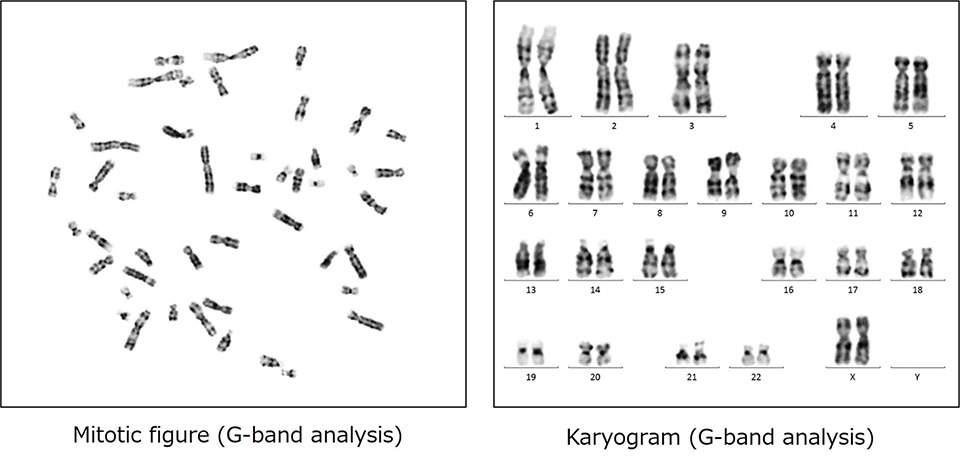
G-band analysis is the most widely used method of karyotype analysis. This method is suitable for testing regenerative medicine to obtain data for new drug application.
| Purpose | Cultured cells (mitotic phase) | |
|---|---|---|
| Evaluation | Determine whether each chromosome is normal or abnormal based on the banding patterns obtained by trypsin–Giemsa staining (G-band analysis) | |
| Resolution | Approximately 5Mb | |
| Application | Strong | Detection of structural abnormalities (inversions, duplications, deletions, translocations, etc.), aneuploidies and marker chromosomes |
| Weak | Detection of microstructural abnormalities, Distinction of complex structural abnormalities | |
Multicolor FISH (mFISH)
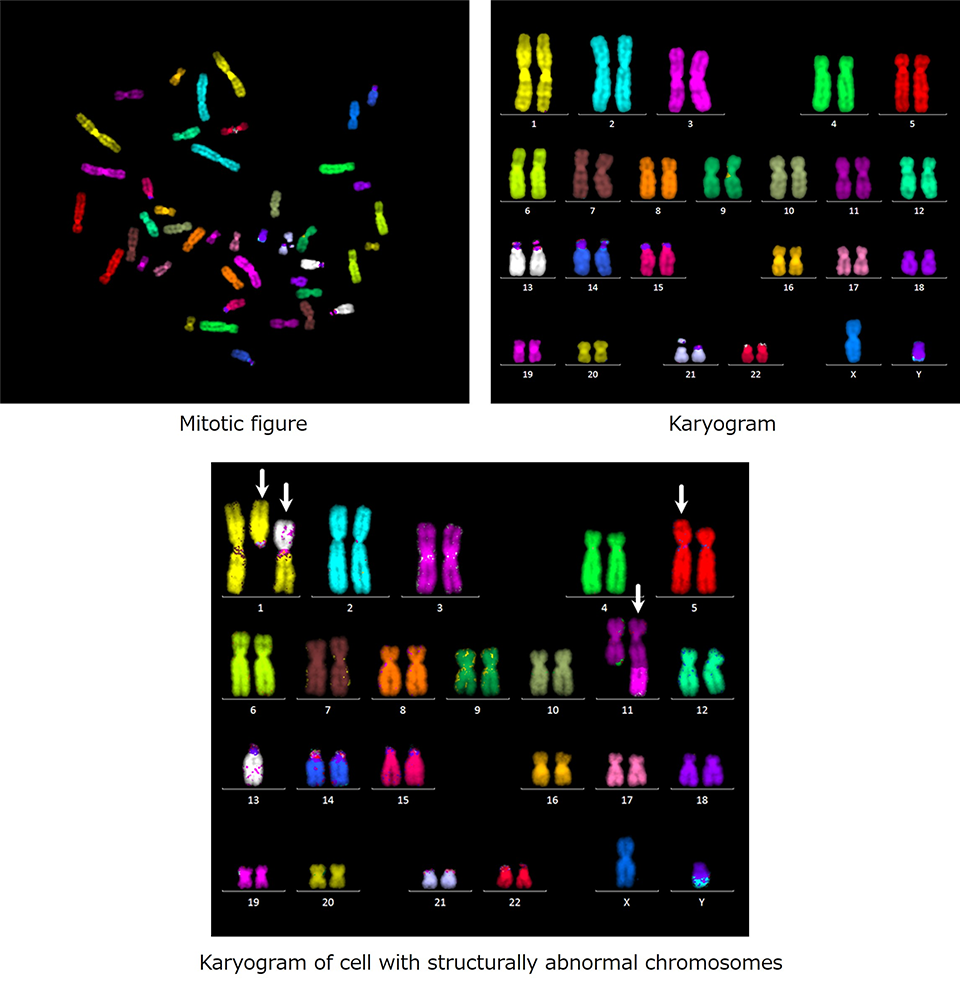
Multicolor FISH (mFISH) is an analytical technique that can detect microstructural abnormalities and distinguish complex structural aberrations that are difficult to evaluate with G-band analysis. Therefore, mFISH is used to complement G-band analysis. This method is also applicable to a wide range of purposes, including the characterization of structurally abnormal chromosomes in tumor cells.
| Purpose | Cultured cells (mitotic phase) | |
|---|---|---|
| Evaluation | Pseudo-color each chromosome by combining stains from chromosome-specific probes labeled with multiple fluorescent tags, and determine whether they are normal or abnormal | |
| Resolution | Approximately 1.5Mb | |
| Application | Strong | Detection of structural abnormalities (translocations), complex structural abnormalities, marker chromosomes and aneuploidy |
| Weak | Detection of structural aberrations between homologous (identical) chromosomes (inversions, duplications, deletions) | |
Points to consider in providing samples derived from human cultured cells
When sending samples obtained from the human body to us, please review and get approval from your ethical review committee, in accordance with the "Ethical Guidelines for Medical and Biological Research Involving Human Subjects", and take necessary measures required by this guideline.
How to contact
To reply to your request promptly and accurately, we will ask you to provide the following information by completing each section of the Contact Form:
Purpose and Background of your Request
Please clarify the objective and background of your request.
Sample Name and Morphology
Please include the following in detail:
- Type of cells (e.g., human iPS cells, cultured cells derived from normal human tissues, etc.)
- Intended delivery format (e.g., frozen vials, culture flasks after seeding, Carnoy-fixed samples)
- Characteristics of the cells (e.g., doubling time, ability to form cell masses)
Preferred Analytical Method
Please specify the analytical methods that you are considering (e.g., G-band analysis, mFISH analysis).
Compliance with Reliability Standards
Please indicate whether the testing is in accordance with the Japan‘s Reliability Criteria *1.
Contact Us for Services