SCAS  Sumika Chemical Analysis Service, Ltd.

X-ray Photoelectron Spectroscopy
XPS: X-ray Photoelectron Spectroscopy (ESCA: Electron Spectroscopy for Chemical Analysis)
  Principle of measurement

Principle of measurement

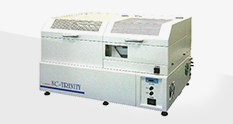
When X-rays are irradiated to a sample surface, the inner-shell electrons of atoms are excited, and photoelectrons are discharged from the sample surface. This technique identifies the elements existing on the sample surface and analyzes their chemical bonding conditions detecting the kinetic energy of the discharged photoelectrons.

Ek=hv-Eb-φ
Ek: Kinetic energy of discharged photoelectrons
hv: Intrinsic energy of X-rays (known)
Eb: Binding energy of orbital electrons (known)

φ:

Work function inherent in equipment (known)


  Major analytical applications for semiconductor materials

 1.Analysis of outermost surface composition and analysis of bonding condition

Information on the component elements on a substance surface and their chemical bonding conditions can be obtained by measurement on the surface of the substance (approx. 10 nm).
  • Analysis of particles adhering to substrate surface
  • Analysis of oxidation conditions on metallic thin films
  • Calculation of natural oxide film thickness
  • Analysis of CF deposited films
  • Evaluation of corrosion of metallic materials
  • Measurement of magnetic disk lubricating film thickness
  • Analysis of various reaction products
  • Evaluation of modification of surfaces of films and packaging materials

Wide scanning measurement

  2. Analysis by angle resolving method

In-depth information can be obtained non-destructively by changing the photoelectron taking angle. The sensitivity on the polar surface can be improved by considerably reducing the photoelectron taking angle.
  • Change in composition and bonding conditions on outermost layer (10 nm)
  • Analysis of physical adsorbed species
Narrow scanning measurement


  3. In-depth analysis (depth profiling)

Combining the above technique with sputtering by ion (AR or Xe) irradiation enables to obtain information on the composition, changes in bonding conditions and diffusion conditions from the surface to the depth.
  • Analysis of composition of various thin films
  • Evaluation of thin film thickness
  • Investigation of interfaces of multi-layer films
Depth profiling
Depth profiling


  4. Analysis in linear direction (line profiling)

The analysis point is automatically shifted linearly, and the distribution between any two points on the sample surface can be determined. This technique can be applied to surface analysis (mapping).
  • Examination of distribution of lubricating film thickness on magnetic disk
  • Examination of distribution of surface contamination
  • Examination of distribution of oxidization level on surface
 
Back
  Precautions for Using the Website     Site Map     Contact Us